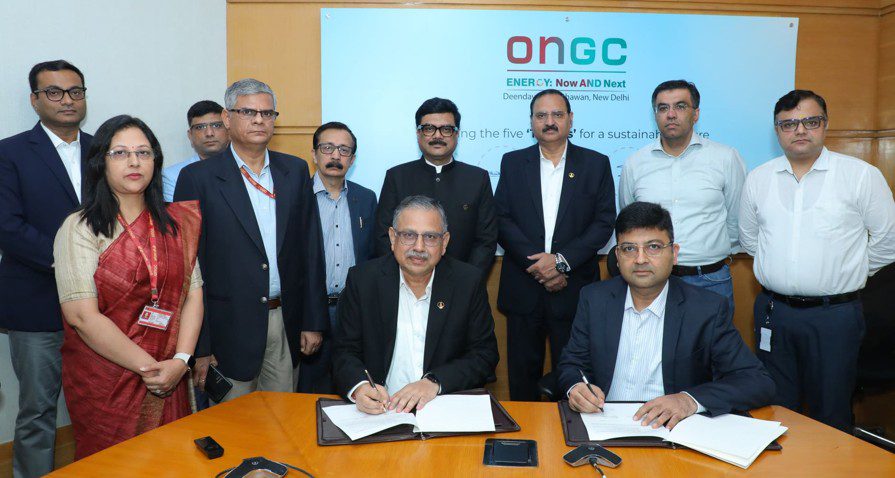
Oil and Natural Gas Corporation Limited (ONGC) and private sector major Cairn Oil & Gas have signed an important Memorandum of Understanding (MoU). The MoU has been signed for early commercial monetisation of the Jantapathar gas field of Upper Assam Shelf South Block in Assam.
Under this partnership, the two companies will jointly develop a strategy for gas extraction from an exploration well named JP-1Z. The collaboration aims to not only speed up production but also establish North-East India as a strong hub on India’s hydrocarbon map.
Several senior officials were present during the signing of the agreement. These include Arunangshu Sarkar (Director, S&CA) and O.p. Dr. P.K. Sinha (Director – Exploration). Cairn Oil & Gas was represented by Rakesh Agarwal (Chief Policy & Regulatory Officer) and Mandeep Narang (Chief Production Officer).
According to sources, this agreement is a shining example of a public-private sector partnership that aims to strengthen the country’s energy security. Under this, expeditious exploitation, processing and market access of discovered gas reserves will be ensured.
Experts believe that Assam and the entire North-East region still have undeveloped hydrocarbon reserves, which will be used in the right direction to meet India’s energy needs. This cooperation is also fully compatible with the government’s national goals such as ‘Hydrocarbon Vision 2030′ and ‘Purvodaya Mission‘.
It is noteworthy that exploration activities were already going on in the Jantapathar area, but due to lack of technical and operational support, the production was not able to pick up. Now, coupled with ONGC’s expertise and Cairn’s technical proficiency, the project is expected to get a new direction and momentum.
Experts believe that this will not only increase energy production, but will also have a positive impact on socio-economic aspects such as employment at the local level, infrastructure development and increase in revenue.
Overall, this partnership is another strong step towards India’s energy self-reliance and shows how public and private entities can work together to better harness the country’s strategic resources.