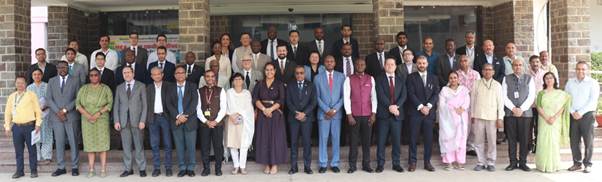
New Delhi,: The Central Electricity Authority (CEA) organised the first day of a two-day international conference-cum-exhibition on October 14, 2026, at the Manekshaw Centre in New Delhi, focusing on the theme “Making Indian Power Sector AI Enabled”. The event brought together government officials and power-sector stakeholders to explore the use of artificial intelligence (AI) across electricity generation, transmission, distribution and renewable energy integration.
The conference aims to develop a coordinated approach to AI adoption across India’s electricity value chain, with an emphasis on operational efficiency, grid reliability, digitalisation and responsible technology deployment.
Senior Ministers and Officials Attend Inaugural Session
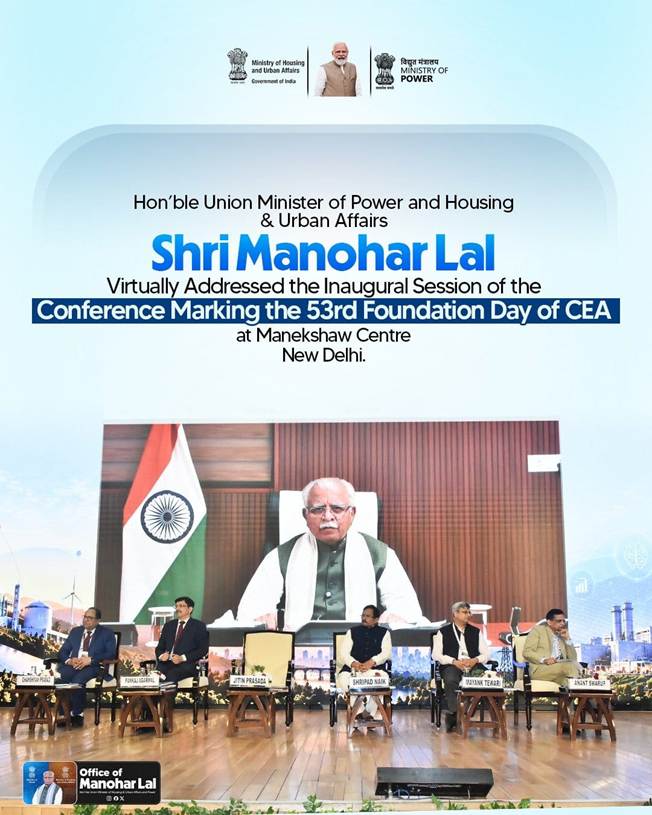
Union Minister for Power and Housing and Urban Affairs Manohar Lal and Union Minister of Consumer Affairs, Food and Public Distribution, New and Renewable Energy Prahlad Joshi conveyed their messages on the occasion.
The inauguration was attended by Union Minister of State for Power and New and Renewable Energy Shripad Yesso Naik; Union Minister of State for Commerce and Industry and Electronics and Information Technology Jitin Prasada; Power Secretary Pankaj Agarwal; CEA Chairperson Ghanshyam Prasad; and Additional Secretary in the Ministry of New and Renewable Energy Mayank Tewari.
During the inaugural session, senior officials highlighted the need to modernise India’s power sector in response to emerging technological developments and changing operational requirements.
The CEA has also formed a team of 54 AI enthusiasts and brand ambassadors to promote AI adoption across different areas of the power sector. The discussions emphasised that power utilities could establish dedicated AI teams to support implementation and encourage wider use of the technology.
CEA Launches Vidhyut Dwar Portal and Releases Transmission Manual
The inaugural session featured the launch of the CEA’s Vidhyut Dwar Portal and the release of the CEA Manual on Transmission Planning Criteria, 2026.
CEA Employee Awards were also presented to recognise outstanding performance and contributions by employees. These initiatives formed part of the broader programme to strengthen institutional capabilities and improve the functioning of the power sector.
Six Technical Sessions Explore AI Applications
The first day featured six parallel thematic discussions covering major areas of electricity operations and planning:
- Conventional power generation: AI applications for heat-rate and combustion optimisation, predictive maintenance, digital twins, emissions monitoring and flexible plant operations.
- Regulatory reforms: Advanced analytics for tariff filings, compliance monitoring, regulatory knowledge management and market surveillance, with AI supporting rather than replacing statutory decision-making.
- Renewable energy integration: AI-based forecasting, energy storage optimisation, congestion management and coordination of distributed energy resources.
- Distribution modernisation: Demand forecasting, outage detection, transformer maintenance, energy-loss analysis, billing, revenue assurance and consumer services.
- Transmission and grid stability: AI-enabled network planning, drone inspections, predictive maintenance, dynamic line rating, contingency analysis and system restoration preparedness.
- Rooftop solar and microgrids: Intelligent planning of rooftop solar, storage optimisation, autonomous microgrid operations, demand response and coordination of electric vehicles and flexible electricity loads.
The discussions examined how AI could help conventional power plants improve operational efficiency while responding more flexibly to fluctuations in electricity demand and the increasing share of renewable energy.
For distribution utilities, the technology could support better use of smart-meter and network data to identify faults, reduce losses, improve maintenance planning and make consumer services more responsive.
In transmission systems, AI-based tools could help with network planning, asset inspections and grid-stability analysis. Meanwhile, renewable energy sessions focused on forecasting generation and demand more accurately and coordinating solar, storage and other distributed resources.
Focus on Responsible and Scalable AI Adoption
A key theme across the sessions was the need to move beyond isolated technology demonstrations towards practical applications that can be implemented and scaled across the electricity sector.
Participants highlighted the importance of reliable data, interoperable systems, cybersecurity, appropriate safeguards, institutional expertise and measurable performance indicators. Discussions on regulatory applications also stressed that AI should remain a human-supervised decision-support tool, preserving accountability and procedural fairness.
The two-day conference is part of a broader initiative to establish a coordinated, outcome-oriented approach to AI adoption in India’s power sector. The initiative seeks to support efficient electricity supply, flexible and reliable grids, responsive institutions, secure digital infrastructure and stronger domestic technological capabilities.
Source: (PIB),