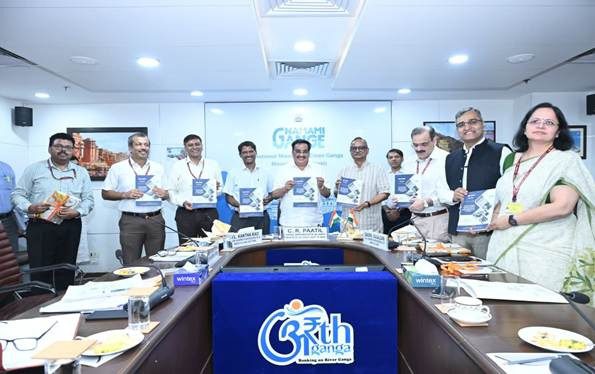
16th meeting of the Empowered Task Force on Ganga Rejuvenation was held today under the chairmanship of the Union Minister for Jal Shakti, C.R. Paatil, bringing together key stakeholders from central ministries, state governments, and river management authorities to review progress and set actionable targets for river conservation and pollution abatement.
The meeting focused on wetland protection, pollution control, river rejuvenation, and regulatory strengthening, including a review of small rivers like the Niranjana (Falgu) and a special presentation on the ecological and geomorphic impacts of sand mining in large rivers. The project report, prepared by IIT Kanpur and supported by NMCG, highlights mitigation strategies and policy recommendations to regulate sand mining.
The Minister emphasized that Ganga Rejuvenation is critical not only for ecology but also for India’s cultural heritage, livelihoods, and flood management, calling for time-bound and coordinated action across states. Wetlands, in particular, were identified as essential for biodiversity, groundwater recharge, and ecological balance.
Wetland Assessment: 282 wetlands in Uttar Pradesh and 387 in Bihar were evaluated, with 59 identified as high priority for legal protection.
Pollution Abatement: Urban sewage treatment capacity in Uttar Pradesh stands at 4,651 MLD, with 1,708 MLD under construction; the focus will now expand to smaller urban bodies.
Small River Revival: “Namami Niranjana Campaign” aims to restore the Niranjana River through afforestation, rainwater conservation, community awareness, and sustainable farming practices.
Sand Mining Report: High-resolution data and drone surveys analyzed ecological impacts, forming the basis for regulatory measures and policy frameworks.
Regulatory Strengthening: States urged to implement Central Water Commission guidelines, enforce floodplain demarcation, and comply with NMCG Cell approvals for activities in sensitive river zones.
The meeting saw participation from Secretaries and Executive Directors of the Department of Water Resources, NMCG, State Missions for Clean Ganga in UP, Bihar, Jharkhand, and West Bengal, along with technical and legal experts involved in river management.
The decisions and directives from the ETF meeting aim to ensure cleaner rivers, secure livelihoods, and safeguard cultural and ecological heritage. Expedited action on wetland notifications, pollution abatement, and river restoration will directly benefit millions of residents dependent on the Ganga and its tributaries.
Union Minister stressed: “The Ganga is not just a river. It is our culture, our faith, and our lifeline. All concerned departments and states must work together to make the Ganga ‘Aviral and Nirmal’ in a time-bound manner.”