Adoption of Circular Approaches Vital for Achieving Resource Efficiency and Sustainable Growth: Shri Bhupender Yadav
Key Strategies for a Successful Circular Economy Outlined: Redesigning Products, Investment in Advanced Technologies, Strengthening Supply Chains, and Promoting Consumer Awareness
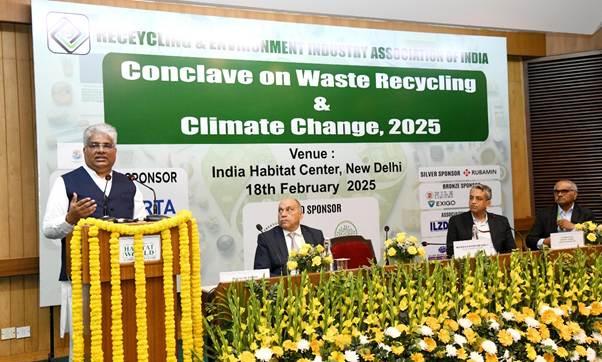
In a landmark event, Union Minister for Environment, Forest, and Climate Change, Shri Bhupender Yadav, inaugurated the ‘Waste Recycling & Climate Change 2025’ conclave, organized by the Recycling and Environment Industry Association of India (REIAI). The day-long conclave brought together industry leaders, environmental scientists, waste management professionals, and policymakers to discuss the importance of a circular economy in addressing waste management challenges and combating climate change.
During his address, Shri Yadav emphasized that India generates approximately 62 million tonnes of waste annually, with a significant increase in plastic, electronic, and hazardous waste. He underscored the limitations of the traditional linear economic model—take, make, dispose—and stressed the urgent need for a paradigm shift. “”The circular economy isn’t merely an option; it is crucial.” consume, and manage materials,” he said.
The Minister highlighted the need for India to move from waste management to capitalizing on the economic potential of recycling through the “Waste to Wealth” initiative under Prime Minister Shri Narendra Modi’s leadership. Shri Yadav pointed out that the circular economy can reduce the pressure on landfills, conserve natural resources, and foster industrial innovation, economic competitiveness, and job creation.
Looking ahead, he projected that India’s circular economy will be worth $2 trillion by 2050, creating 10 million jobs. He also noted that this transformation presents a significant opportunity for start-ups and new developers of recycled products. He encouraged the adoption of sustainable practices that align with India’s vision of “Atmanirbhar Bharat” and the principles of environmental sustainability.
Shri Yadav urged the recycling industry to innovate and adopt new technologies to reduce dependence on natural resources and minimize imports of critical minerals required for economic growth. “He further emphasized that the principles of the circular economy could offer significant economic advantages, boosting the competitiveness of Indian industries on the global stage.”
The Minister also shared that the Ministry has been at the forefront of developing policies and regulations to support the recycling industry, such as Extended Producer Responsibility (EPR) frameworks. These policies encourage recyclers, integrate the informal sector into formal systems, and promote eco-friendly production across various industries.
Shri Yadav presented four key strategies for promoting circular economy practices:
- Redesigning Products for Circularity: Companies must move away from single-use models and design products that are recyclable. By integrating biodegradable, reusable, and modular components, companies can extend product life cycles and reduce waste.
- Investment in Advanced Recycling Technologies: Emerging technologies are critical to transforming waste management systems and improving recovery rates.
- Strengthening Supply Chain Collaboration: Businesses need to collaborate across the value chain to optimize resource utilization and create closed-loop production systems, fostering markets for secondary raw materials.
- Consumer Awareness and Behavioral Change: Active consumer participation is essential for circularity. Companies should invest in campaigns to engage consumers and promote sustainable consumption behaviors.
Dr. Amandeep Garg, Additional Secretary of the Ministry of Environment, Forest, and Climate Change, and Chairman of the Central Pollution Control Board (CPCB), highlighted the vast potential in the recycling sector to reduce imports of critical products essential for economic growth. He encouraged corporate houses to lead the transition to a circular economy by adopting recyclable designs, promoting sustainability, and raising consumer awareness.
The conclave was attended by key figures, including Dr. Ashok Kumar, President of REIAI, and over 200 delegates comprising environmental scientists, waste management professionals, and policymakers.