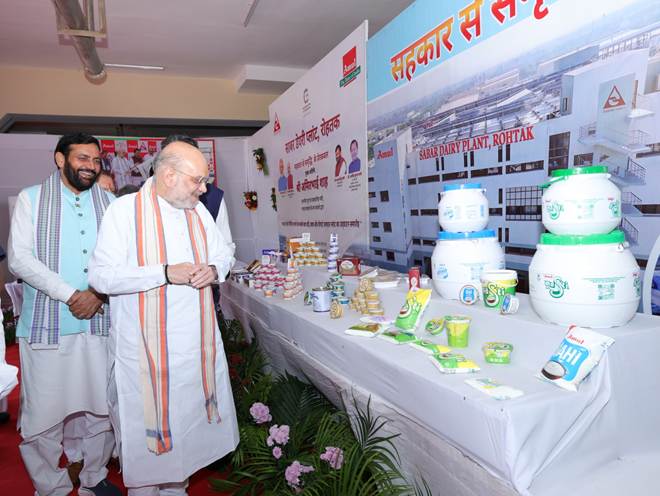
Union Home and Cooperation Minister Amit Shah inaugurated the Sabar Dairy Plant in Rohtak, Haryana today, marking a major step towards strengthening India’s cooperative movement. The ceremony was attended by Haryana Chief Minister Nayab Singh Saini, Union Ministers Krishan Pal Gurjar and Rao Inderjit Singh, along with other dignitaries.
Built with an investment of ₹350 crore, the plant is the country’s largest facility for producing curd, yogurt, buttermilk, and sweets. It will produce 150 metric tonnes of curd, 10 metric tonnes of yogurt, 3 lakh liters of buttermilk, and 10,000 kilograms of sweets daily, significantly benefitting dairy farmers and meeting the demand for dairy products in Delhi-NCR and beyond.
Amit Shah highlighted that under the leadership of Prime Minister Narendra Modi, the cooperative sector has been given renewed strength. The Ministry of Cooperation, established four years ago, has been working with state governments to deepen the cooperative foundation. By 2029, the goal is to have a cooperative society in every panchayat of the country.
Tracing its roots to Gujarat’s Sabarkantha district, Sabar Dairy has expanded to support farmers across nine states. In Gujarat alone, nearly 3.5 million women are running cooperative dairies with an annual turnover of ₹85,000 crore, setting a benchmark for inclusive growth.
India’s dairy sector has recorded a 70 percent growth in the past 11 years, making it the fastest-growing dairy sector in the world. Milk production has risen from 146 million tonnes in 2014–15 to 239 million tonnes, while indigenous cow milk production has increased from 29 million tonnes to 50 million tonnes. Nearly 80 million farmers are directly associated with the sector, raising per capita milk availability from 124 grams to 471 grams per day.
Haryana continues to rank among the top three states in per capita milk availability. Shah underlined that under White Revolution 2.0, the government aims to set up 75,000 new dairy societies and strengthen 46,000 existing cooperatives. India’s milk processing capacity, currently at 66 million liters per day, is targeted to reach 100 million liters per day by 2028–29, ensuring direct benefits for dairy farmers, especially women.
Government has recently established three new national cooperative societies focused on animal feed production, organic manure management, and circular economy initiatives. In addition, flagship schemes such as the National Gokul Mission, National Artificial Insemination Program, Animal Husbandry Infrastructure Development Fund, and the National Animal Disease Control Program are further driving momentum in the sector.
With these measures, India is steadily moving towards self-reliance in the dairy sector. The pace of dairy plant construction and research & development (R&D) has been tripled, ensuring that the sector evolves with a focus on sustainable and inclusive growth in the years to come.