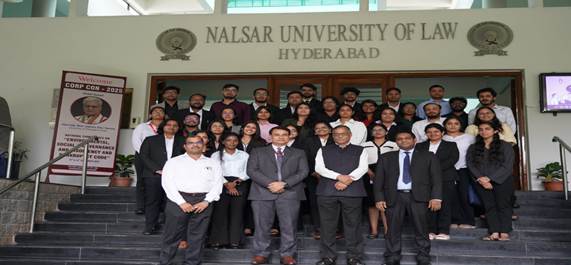
SANDEEP KUMAR |:– NALSAR University of Law, Hyderabad, in collaboration with the Institute of Company Secretaries of India (ICSI), successfully hosted the National Conference Corp-Con 2025 on 12th September 2025, focusing on Environmental, Social, and Governance (ESG) integration and the Insolvency and Bankruptcy Code (IBC 3.0).
The inaugural session, held at the SAARC Law Hall, was chaired by Prof. Srikrishna Deva Rao, Vice-Chancellor of NALSAR University. The conference witnessed the participation of eminent speakers, corporate professionals, and academics from across India.
In the keynote address, Gyaneshwar Kumar Singh, Director General & CEO, Indian Institute of Corporate Affairs, highlighted the significance of ESG integration into corporate law, stakeholder theory, and the forthcoming IBC 3.0 amendments. The address underscored the importance of building trust and collective responsibility among stakeholders in achieving sustainable corporate governance.
The event commenced with a ceremonial lamp-lighting, welcome of dignitaries, and the rendition of the ICSI motto song “Satyam Vada, Dharam Chara”. In his inaugural remarks, the Vice-Chancellor emphasized self-reliance, environmental sustainability, and ESG principles, drawing on landmark legal cases and highlighting the value of the NALSAR–ICSI partnership in advancing ESG and IBL studies. Selected papers from the conference are slated for publication.
The conference featured thought-provoking discussions from CS P. S. Rao, sharing insights on mergers, takeovers, insolvency, and ESG challenges; Inderjit Shaw, emphasizing sustainability integration and stakeholder engagement with examples from Tata, Infosys, and Mahindra; and CS Ranjit Pandey, presenting ESG as a strategic necessity distinct from CSR, along with relevant legal frameworks.
The session concluded with the presentation of souvenirs and a vote of thanks by Prof. P. Sreenivasa Subbha Rao, acknowledging the contributions of participants, organizers, and collaborators.
The conference reinforced ESG and IBC as key pillars for sustainable corporate governance, fostering knowledge exchange, policy discussions, and best practices for the business and academic community in India.