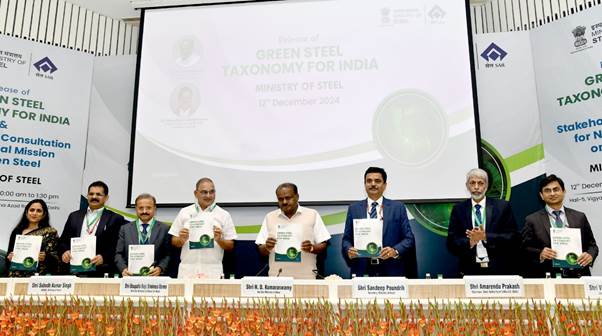
In a pivotal moment for India’s journey toward sustainability, Shri H.D. Kumaraswamy, Union Minister of Steel and Heavy Industries, launched the nation’s first-ever Green Steel Taxonomy on December 12, 2024. The event, held at Vigyan Bhavan, witnessed the participation of Shri Bhupathi Raju Srinivasa Varma, Minister of State for Steel and Heavy Industries, senior officials from the Steel Ministry, industry representatives, think tanks, academia, and international delegates, including a delegation from the European Union.
India has become the first country globally to establish a formal taxonomy for green steel, addressing the absence of a universally accepted definition and signaling its commitment to decarbonizing the steel industry in alignment with its 2070 net-zero target.
Union Minister Shri H.D. Kumaraswamy emphasized the historic significance of the launch, stating, “The release of the Green Steel Taxonomy represents a monumental milestone in our transition toward a low-carbon economy. It underscores our collective dedication to sustainability and innovation within the steel sector.”
Minister of State Shri Bhupathi Raju Srinivasa Varma highlighted the transformative impact of the taxonomy, noting its potential to foster innovation, establish a clear framework for defining green steel, and create a robust market for low-carbon steel products.
Shri Sandeep Poundrik, Secretary of the Steel Ministry, called the adoption of the taxonomy a mandate for achieving environmental sustainability. He remarked that despite challenges, the Ministry, in collaboration with industry stakeholders, is determined to reduce the emission intensity to 2.2 tCO2 per tonne by 2030, ensuring global competitiveness and continued growth for India’s steel sector.
- Green Steel is defined based on CO2 equivalent emission intensity, with the threshold set at 2.2 tonnes of CO2 per tonne of finished steel (tfs).
- The greenness of steel is rated as follows:
- Five-star: Emission intensity < 1.6 tCO2/tfs
- Four-star: Emission intensity between 1.6 and 2.0 tCO2/tfs
- Three-star: Emission intensity between 2.0 and 2.2 tCO2/tfs
- Steel exceeding 2.2 tCO2/tfs is ineligible for a green rating.
- Includes Scope 1, Scope 2, and limited Scope 3 emissions (covering agglomeration, beneficiation, and embodied emissions in raw materials). Excludes upstream mining and downstream transportation emissions.
- Certification Process:
- The National Institute of Secondary Steel Technology (NISST) will serve as the nodal agency for measuring, reporting, and verifying (MRV) emissions, issuing annual certificates, and assigning star ratings.
The event also included stakeholder consultations on the draft National Mission on Green Steel (NMGS) and the Green Steel Public Procurement Policy (GSPPP). The Ministry assured participants that their feedback would be considered in finalizing these policies.
The Ministry of Steel reaffirmed its dedication to driving sustainability and innovation, positioning India’s steel industry as a global leader in low-carbon production. The event concluded with a vote of thanks delivered by Smt. Neha Verma, Director, Ministry of Steel, acknowledging the collaborative efforts of all participants.
India’s Green Steel Taxonomy marks a bold step in reducing carbon emissions and shaping a sustainable future for the nation and the global steel industry.