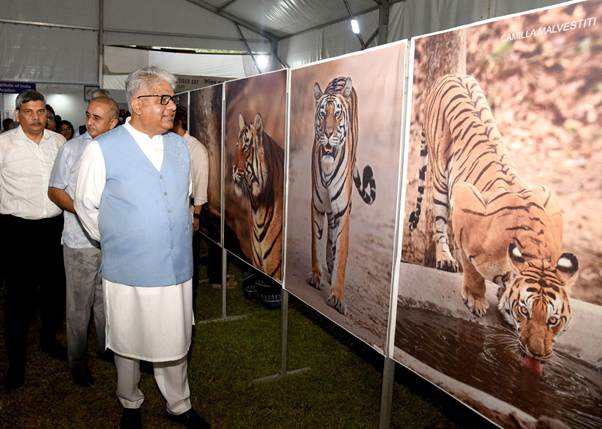
India celebrated Global Tiger Day 2025 with a lively and functional program held at the National Zoological Park in New Delhi, which was chaired by the Union Minister of Environment, Forest and Climate Change, Mr. Bhupendra Yadav.. The event underlined India’s global leadership in tiger conservation and launched some of the world’s biggest eco-parts so far.
Global Tiger Day 2025, Government of India announced a large -scale tree plantation campaign to plant more than 1 lakh saplings in 58 tiger reserves across the country. The program also saw the unveiling of four major wildlife conservation publications, inauguration of forest nursery and the launch of ‘plastic-free Tiger Reserve’ campaign.
The plantation campaign was started simultaneously in all 58 tiger sanctuaries through the National Zoological Park, New Delhi, while virtual mode. The new forest nursery was inaugurated in the Aravalli scenario.
Union Minister of Environment Minister Mr. Bhupendra Yadav and Minister of State for Environment, Forest and Climate Change, Mr. Kirti Vardhan Singh, Forest Officer, Scientist, NGOs, students, community leaders and forest employees of the front row attended the event. The presence of various stakeholders reflects collective commitment to tiger conservation.
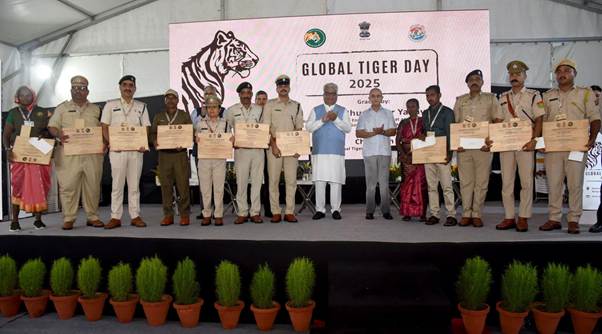
According to Mr. Yadav, the number of tiger sanctuaries of India has increased from 46 to 58 in 2014 to 58 in 2025, which reflects the unwavering dedication of Prime Minister Shri Narendra Modi towards wildlife conservation. The program emphasized a holistic approach to secure the long -term existence of tigers – ecological balance, youth participation, indigenous livelihood and international cooperation.
The Minister, highlighting the emotional and ecological bond between nature and nutrition, urged every citizen to plant a tree in the name of his mother under the ‘Name of a tree mother’.
1. Plantation Campaign: 2,000 indigenous plants will be planted in each of the 58 tiger reserves, which will target dishonored houses.
2. One Nursery: Three new nurseries were started in the Aravalli region to support afforestation using indigenous species.
3. Plastic-free campaign: In the Tiger Reserve, it was started to eliminate single-utilized plastic.
4. Eco-shop exhibition: Community-based products were demonstrated from the tiger landscape, which promote permanent enterprises and reduce dependence on forest resources.

, 📚 Book release
1. Status of small cats in the tiger landscape of India
2. Stripes magazine – Global Tiger Day Special Edition
3. Tiger Reserve waterfalls in India
4. Water body inside Tiger Reserve of India
NTCA was distributed in 7 categories recognizing awards:
1. Sacrifice in the line of duty
2. Wildlife Crime Investigation
3. Anti -poaching efforts
4. Humigation management
5. Community participation
6. Voluntary Village Transfer
7. Monitoring of wildlife
Mr. Yadav highlighted the International Big Cat Alliance (IBCA) launched by India, which now includes 24 countries. The coalition wants to protect seven big cat species found globally, hosting the IBCA headquarters.