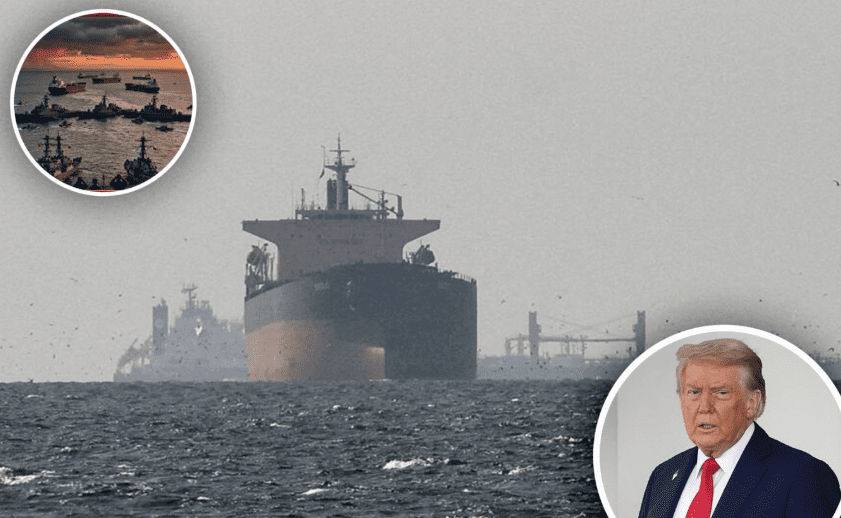
The high-stakes peace talks between the United States and Iran, held in Islamabad under Pakistan’s mediation, have ended in failure. After 21 gruelling hours of marathon negotiations, US Vice President JD Vance confirmed that no agreement was reached and departed for Washington. In a dramatic escalation, President Trump has now ordered the US Navy to immediately begin blockading the Strait of Hormuz — the world’s most critical oil shipping route — raising fears of an all-out return to war in the Middle East.
The talks — held at the Serena Hotel in Islamabad — were the highest-level face-to-face engagement between the United States and Iran since the 1979 Islamic Revolution, and the first direct dialogue between Washington and Tehran since the current war began on February 28, 2026, when the US and Israel launched strikes on Iran.
A fragile two-week ceasefire, announced on April 7, had given both sides a precious window for diplomacy. After 21 hours, that window has slammed shut.
The US delegation was led by Vice President JD Vance, along with special envoy Steve Witkoff and Trump’s son-in-law Jared Kushner. Iran’s delegation was led by Parliament Speaker Mohammad Bagher Ghalibaf and Foreign Minister Abbas Araghchi. The city of Islamabad, home to over 2 million people, was placed under a complete lockdown with thousands of troops and paramilitary forces deployed for security.
Speaking at a press conference before boarding Air Force Two, Vance said:
“We have been at it for 21 hours and we’ve had a number of substantive discussions with the Iranians. That’s the good news. The bad news is that we have not reached an agreement. I think that’s bad news for Iran much more than it is for the United States of America.”
He added: “The simple fact is that we need to see an affirmative commitment that they will not seek a nuclear weapon, and they will not seek the tools that would enable them to quickly achieve a nuclear weapon.”
Vance left Pakistan with America’s “final and best offer” on the table, saying the ball is now in Iran’s court.
Iran’s Parliament Speaker Ghalibaf, after returning to Tehran, took a defiant tone:
“If they fight, we will fight, and if they come forward with logic, we will deal with logic. We will not bow to any threats — let them test our will once again so that we can teach them a bigger lesson.”
Iran’s Foreign Ministry said the US made “excessive and illegal demands” and that the failure was Washington’s fault. Spokesman Esmaeil Baqaei said some partial progress was made during talks — “On some issues we actually reached mutual understanding, but there was agap over two or three important issues and ultimately the talks didn’t result in an agreement.”
Notably, Iran’s foreign ministry said Tehran was “inches away” from a deal at one point — but the negotiations ultimately collapsed. Iran also said it entered the talks in “good faith” and blamed the US for introducing new demands mid-negotiation, particularly on the Strait of Hormuz.
THE 3 KEY STICKING POINTS:
🔴 1. NUCLEAR PROGRAMME
America’s core demand: Iran must completely abandon its uranium enrichment programme and make a binding commitment to never seek nuclear weapons. Iran flatly refused.
Trump posted on Truth Social: “The meeting went well, most points were agreed to, but the only point that really mattered — NUCLEAR — was not.”
🔴 2. STRAIT OF HORMUZ
The US demanded free and unrestricted passage through the Strait of Hormuz for all international shipping. Iran’s Deputy Parliament Speaker declared the strait a “red line” and said passage fees are payable only in Iranian rials — Iran’s currency.
During the talks, two US Navy guided-missile destroyers — USS Frank E. Peterson and USS Michael Murphy — transited the Strait for the first time since the war began, as part of a mine-clearing mission.
🔴 3. SANCTIONS & REPARATIONS
Iran demanded the complete lifting of all US sanctions, the unfreezing of billions in overseas assets, and war reparations. The US refused all three.
⚡ BREAKING: TRUMP ORDERS HORMUZ BLOCKADE
In the most dramatic post-talks development, President Trump announced on his Truth Social platform that the US Navy will immediately begin blockading the Strait of Hormuz:
“I have instructed our Navy to seek and interdict every vessel in International Waters that has paid a toll to Iran. No one who pays an illegal toll will have safe passage.”
The US military confirmed it has begun setting conditions for the blockade. This is an unprecedented move that could completely cut off Iran’s maritime access and trigger a direct military confrontation.
Iran responded on X via its embassy in Austria: “A blockade blocks. It cannot ‘open’ the Strait of Hormuz — only restrict it.”
RUSSIA OFFERS TO HELP:
In a significant diplomatic development, Russian President Vladimir Putin has expressed readiness to assist peace efforts in a call with Iran’s President Masoud Pezeshkian, according to the Kremlin. This suggests Russia may attempt to play a mediating role if the situation deteriorates further.
ISRAEL-LEBANON UPDATE:
Even as US-Iran talks failed, a separate diplomatic track appears to be opening. Israeli Prime Minister Netanyahu said he wants “a real peace agreement that will last for generations” with Lebanon, and the Israeli ambassador to the US has spoken to Lebanon’s envoy for the first time. Talks between Israel and Lebanon are expected to begin on Tuesday, mediated by the US — though Netanyahu said Hezbollah must be disarmed first.
Meanwhile, Israel’s bombing of Lebanon continues — Lebanon’s health ministry confirmed the death toll has crossed 2,020 civilians killed and over 6,400 injured.
Ali Vaez, Iran Project Director at the International Crisis Group, said: “The likelier scenario is not immediate war, but a volatile period of pressure, signaling, and last-minute attempts to prevent a wider conflagration. The path forward, if there is one, lies in a limited, reciprocal deal that buys time and lowers the temperature.”
Chinese analysts warned: “If the thorny issues cannot be resolved at the negotiating table, it is very likely they will return to the battlefield to settle it, with the Hormuz Strait being a possible flashpoint as the US could seek to open the key channel with force.”
IMPACT ON GLOBAL OIL MARKETS:
Oil prices jumped sharply on Monday morning, April 13, as markets opened amid fears of an escalating conflict. US and global crude benchmarks climbed steeply as investors priced in the risk of a full blockade of the Strait of Hormuz — through which roughly 20% of the world’s daily oil supply passes.
Pakistan’s Foreign Minister Ishaq Dar urged both sides to uphold the ceasefire and maintain dialogue: “It is imperative that the parties continue to uphold their commitment to ceasefire. Pakistan has been and will continue to play its role to facilitate engagement and dialogue between Iran and the United States in the days to come.”
⚠️ The fragile ceasefire — valid until April 22, 2026 — is now under extreme strain.
⚠️ Trump’s Hormuz blockade order could trigger direct military confrontation at sea.
⚠️ No members of the US delegation remained in Pakistan for back-channel talks after Vance’s departure — a sign Washington is not planning an immediate return to negotiations.
⚠️ Iran has vowed to defend the strait with force if needed.
⚠️ The global oil market faces serious disruption if the Hormuz situation escalates further.
The world is holding its breath. The next 10 days — before the April 22 ceasefire deadline — may determine whether this conflict reignites into full-scale war.
HUMAN COST SO FAR:
According to available figures:
– Iran: At least 1,701 civilians killed, including 254 children (since war began Feb 28)
– Lebanon: Over 2,020 killed, 6,400+ injured (from Israeli strikes)
– Gulf nations: At least 32 killed in Iranian attacks
– Israel: At least 20 deaths recorded
– US service members: 13 killed