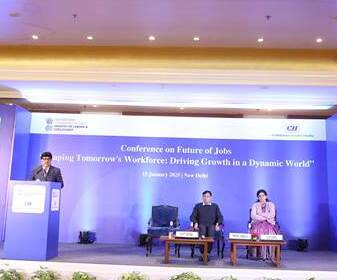
The Ministry of Labour & Employment (MoLE), in partnership with the Confederation of Indian Industry (CII), organized the “Conference on Future of Jobs” on January 15, 2025, in New Delhi. The event, themed “Shaping Tomorrow’s Workforce: Driving Growth in a Dynamic World,” brought together policymakers, industry leaders, and experts to explore strategies for building a future-ready workforce tailored to evolving global and domestic needs.
Ministerial Address: Building a Global Talent Hub
Union Minister Dr. Mansukh Mandaviya emphasized the importance of aligning education with employment through robust skill development initiatives. “India has the potential to address global workforce shortages by fostering innovation, enhancing productivity, and preparing individuals with practical expertise,” he said. Highlighting efforts like the Mutual Recognition of Skills and Standards, Dr. Mandaviya underlined India’s goal of becoming a global talent hub.
Key Challenges and Opportunities
Smt. Sumita Dawra, Secretary of the Ministry, outlined three critical focus areas for workforce readiness:
- Digital Proficiency: Preparing workers for tech-driven industries.
- Inclusivity: Building a diverse and equitable workforce.
- Sustainability: Integrating eco-friendly practices into workforce culture.
She underscored India’s position as the “GCC Capital of the World” with over 1,700 Global Capability Centres employing two million people—a number expected to rise significantly by 2030.
Sector-Specific Highlights
1. Manufacturing
- Proposal: A National Employment Policy to align schemes across sectors and a dedicated Task Force for Future Jobs.
- Focus: Upskilling programs, apprenticeship models, and a career progression framework to empower workers.
- Goal: Enhance competitiveness, especially among MSMEs, and create millions of skilled jobs.
2. Green Jobs
- India ranks fourth in renewable energy employment, with one million jobs in 2023.
- Projections: 10.3 million new global clean energy jobs by 2030, driven by non-fossil fuel targets.
- Key Roles: Renewable Energy Technicians, Sustainability Consultants, and Carbon Market Analysts.
3. Hospitality & Tourism
- The industry is rebounding post-pandemic, driven by trends like wellness and spiritual tourism.
- Economic Vision: Aiming for $3 trillion by 2047, the sector seeks ‘Industry Status’ to unlock growth potential.
- Transferable Skills: Preparing workers for opportunities in retail and BPO sectors.
4. Smart Manufacturing
- Aims to contribute 25% to GDP, positioning India as the second-largest global manufacturing hub.
- Needs: Advanced skilling in analytics, automation, and emerging technologies.
- Impact: Integration of MSMEs into global value chains and creation of over 100 million skilled jobs.
5. Logistics
- India’s logistics sector is expected to grow to $350 billion by 2030, fueled by e-commerce and government initiatives like the PM Gati Shakti National Master Plan.
- Trends: AI, automation, and sustainable practices are reshaping supply chains and workforce roles.
6. Healthcare
- With healthcare contributing 10% to global GDP, India’s sector is growing at 7-10% annually.
- Challenges: Addressing a shortfall of 2.7 million healthcare workers by 2030 through digital health initiatives and rural healthcare development.
Key Recommendations
The conference concluded with actionable strategies to empower India’s workforce for a dynamic global economy:
- Expand skill development and upskilling programs.
- Strengthen public-private collaborations for inclusive growth.
- Promote digital literacy and eco-conscious workforce values.
- Prioritize inclusivity and sustainability in all workforce development initiatives.
By addressing these priorities, India is positioned to not only meet domestic workforce demands but also become a key contributor to solving global workforce shortages.