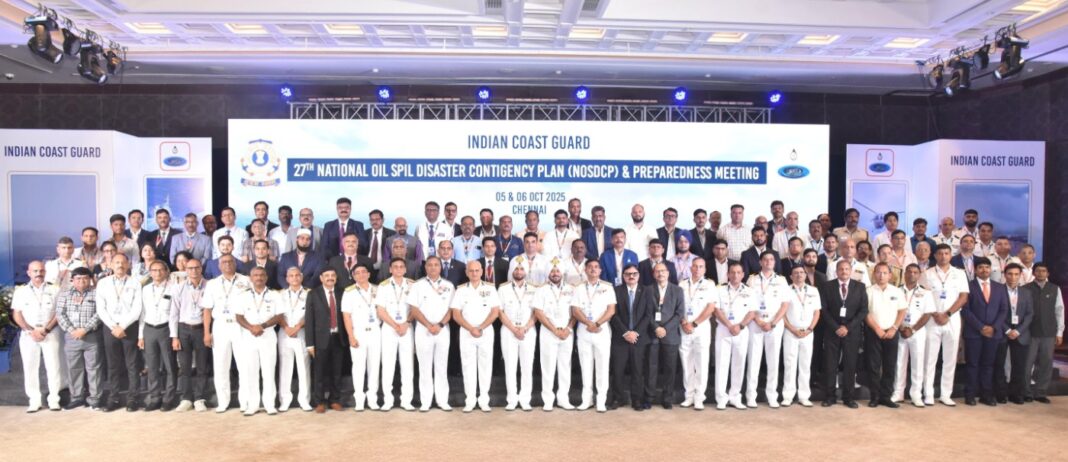
Indian Coast Guard (ICG) conducted the 10thedition of the National Level Pollution Response Exercise (NATPOLREX-X) along with the 27th National Oil Spill Disaster Contingency Plan (NOSDCP) & Preparedness Meeting on 05–06 Oct 2025, off the coast of Chennai, Tamil Nadu. This biennial flagship exercise is a cornerstone in strengthening India’s preparedness to combat marine oil spills in accordance with the National Oil Spill Disaster Contingency Plan (NOSDCP).
Event was overseen by Director General Paramesh Sivamani, AVSM, PTM, TM, Director General, Indian Coast Guard, and Chairperson, NOSDCP, who reviewed the exercise and assessed the operational readiness, response coordination, and inter-agency synergy among participating stakeholders.
The large scale exercise witnessed enthusiastic participation from a wide spectrum of stakeholders, including representatives from central ministries, coastal state governments, major ports, oil handling agencies, and maritime organizations. Notably, 40 foreign observers from 32 countries and over 105 national delegates attended the exercise and actively contributed to discussions in the 27th NOSDCP meeting, held concurrently.
The technical sessions of NATPOLREX-X featured insightful presentations on topics of current relevance, including Nurdle Spills and their Environmental Impact, Case Studies on Hazardous and Noxious Substances (HNS), Post-Spill Monitoring & Environmental Impact Assessments, Shoreline Cleanup following MV MSC ELSA 3 Incident, ICG Coordination and Response during MV MSC ELSA 3 & MV Wan Mai 503 Incidents.
These sessions provided a knowledge-sharing platform for environmental scientists, policy makers, and operational experts to collaboratively discuss strategies for effective spill response and post-incident recovery.
ICG deployed a full spectrum of assets to demonstrate its oil spill response capabilities, including Pollution Control Vessels (PCVs), Offshore Patrol Vessels (OPVs), Fast Patrol Vessels (FPVs), Chetak and Dornier Aircraft configured for aerial surveillance and pollution response. The current exercise is unique in the fact that it incorporates the first ever shoreline clean up drill, at Marina Beach, by the Greater Chennai Cooperation, State Pollution Control Board, SDMA, Police and other agencies of Tamil Nadu administration as part of the simulated incident.
These demonstrations validated the efficiency and readiness of the ICG’s multi-layered pollution response mechanism, while also emphasizing the importance of joint operations with ports and coastal authorities.
In line with the Hon’ble Prime Minister’s vision of ‘Aatmanirbhar Bharat’, NATPOLREX-X also showcased India’s growing capabilities in maritime technology and industrial manufacturing under the ‘Make in India’ initiative. Stakeholders such as major ports deployed indigenous maritime assets, highlighting a unified and homegrown approach to marine environmental protection.
ICG has been entrusted with the responsibility of protecting the marine environment in India’s maritime zones since 07 March 1986, following the transfer of responsibilities from the Ministry of Shipping. The National Oil Spill Disaster Contingency Plan (NOSDCP), drafted by the ICG and approved by the Committee of Secretaries in 1993, continues to serve as the foundational framework for oil spill preparedness in India. To operationalize the plan, the ICG has established four Pollution Response Centres at Mumbai, Chennai, Port Blair, and Vadinar.
Given that over 75% of India’s energy needs are met through seaborne oil imports, ensuring a robust national oil spill response system is not just critical, it is strategic. The ICG continues to serve as the Central Coordinating Authority for oil spill response, committed to ensuring rapid, effective, and coordinated action in the event of any maritime environmental incident.
NATPOLREX-X has reaffirmed India’s unwavering commitment to the preservation of the marine ecosystem. It has further strengthened national and international collaboration in pollution response preparedness, setting new benchmarks for inter-agency coordination, technological integration, and environmental stewardship.